Together, COBIT and ITIL provide a top-down approach for IT governance and service management. The COBIT Management Guide provides a comprehensive approach to managing IT goals and priorities. Used together, the power of both approaches is amplified, with a greater likelihood of management support and direction, and a more efficient use of implementing resources.
Structuring the process
The organisation needs an effective action plan that fits its particular circumstances and needs, but some recommendations are common to all businesses:
• Ensure that the task of setting governance standards is in terms of senior management and funding this project.
• Deficiencies and ensuring that IT issues are recognised and reported
• Consult with management to ensure coordination of projects with positive impacts on client activities.
• Developing dashboards to assess IT quality
Planning
Establish an institutional structure (ideally within a global IT governance initiative) with specific roles and goals. Ensure stakeholder engagement.
• Identify project risks
• Build development plans and identify priority priorities to improve leadership and governance.
• Consider supporting COBIT performance goals using ITIL’s most comprehensive guidelines.
• Monitor outcomes, create a dashboard system to monitor current performance and track future changes.
Pitfalls to avoid
There are also some obvious rules that management should follow to avoid the pitfalls:
• Treat the initiative with a series of phases to implement a project activity.
• Implementation includes social and modern procedures. Therefore, activating and motivating change is a key success factor.
• Provide clear understanding of goals.
• Manage waiting times. Success in most companies takes time and requires continuous improvement.
• Focus first on where adjustments and enhancements are easiest and build from there, step by step
Since both frameworks are designed by various organisations and serve different purposes, one might think they are not overlapping. That’s an incorrect assumption, though. Research and training showed that both structures complement each other during the fintech interaction. While COBIT helps determine what IT should do, ITIL prescribes how to optimise the use of resources within the IT context. Although the processes are different, they have several touchpoints (e.g. Create, Acquire and Install[ BAI] from the COBIT 5 domain, process BAI06 Manage Changes is roughly equivalent to ITIL Change Management; process BAI10 Manage Configuration is roughly equivalent to ITIL Configuration Management).
By following the guidance provided by the COBIT 5 enablers on implementation, it is easy to understand how COBIT 5 helps to define appropriate IT investment, strategy, design, implementation and management by linking IT priorities to IT-related goals that support overall business goals. The Cascade of COBIT 5 priorities helps match IT-related goals and business goals and therefore helps to simplify and prioritise IT processes (Figure 1). The COBIT 5 goals cascade showed stakeholders in the fintech enterprise how to prioritise focus areas when implementing ITIL v3 processes and, in effect, how to assess the number of processes and maturity rates required for a well-run business.
Figure – Source: ISACA, COBIT 5, USA, 2012. Reprinted with permission.
01 Alignment of IT and business strategy; 04 Managed IT-related business risk; 07 Provision of business-related IT services; 08 Adequate use of software, data and technology solutions; 09 IT Agility; 010 Protection of information processing, infrastructure and applications;
The fintech company concluded, based on the IT-related objectives, that certain COBIT 5 processes allowed the effective scope of ITIL v3 service management process concepts for the effective delivery of IT services.
The relevant governance processes included Evaluation, Direct and Monitor (EDM) EDM01, EDM02, EDM03.Priority management processes included Alignment, Planning and Organization (APO) APO12 Risk Management and APO13 Security Management (Figure 2), mapping ITIL v3 Service Design information security management.
Figure02 – Source: ISACA, COBIT 5, USA, 2012. Reprinted with permission.
Although in some ways COBIT 5 and ITIL overlap — and both are responsible for ensuring that IT helps business — frameworks do not share the same emphasis. ITIL’s primary focus is on IT service strategy and management, while COBIT 5’s primary focus is on end-to-end corporate governance over IT through the application of the COBIT 5 principles shown in Figure 3.
COBIT 5 covers the entire organisation, ensuring the achievement of governance, maintaining stakeholder interest, and using comprehensive approaches to IT management and governance. This is done through policies, procedures, individuals, data, culture, and organisational structures, products, and applications that are incorporated and integrated within a single overarching framework to promote incorporation and customization. ITIL is entirely focused on IT and how interest should be handled.
The guide of good practices has been designed to meet the need to organised the process management system, it reacts to this need with more information and performance, and ITIL remains the most commonly used guideline in IT infrastructure and service management.
For many years, information technology professionals in IT service administration (ITSM) have been using COBIT (Control Goals for Information and Related Technology) and ITIL (Information Tech Infrastructure Library) for many years. Together COBIT and ITIL offer guidelines to the management of IT services by businesses, both internally and from third parties such as service providers and business partners.
The way to control the IT infrastructure could be described as ITIL over the whole lifecycle. COBIT is concerned with management of enterprise IT with a view to maximising the value created by the enterprise, allowed by IT expenditure and managing risk and capital. COBIT 5 identifies concepts and skills enabling an organisation to meet the needs of shareholders, especially those related to the use of IT assets and resources throughout the business. ITIL further describes those parts of company IT that are service managers (process activities, organisational structures, etc.).
Generally speaking, COBIT is broader than ITIL in its scope of coverage.
Purpose: ITIL is an ITSM framework. COBIT is an IT practice (and now governance) framework. ITSM has grown to mean “all of IT management seen from a service perspective” but that service slant or bias remains. COBIT is intended to be a comprehensive description of all IT practices. It may not do that perfectly but it comes much closer than ITIL because it doesn’t constrain itself to ITSM.
Coverage: ITIL covers less than half of COBIT’s range and only completely covers about a quarter of the practices (8 of the 34 COBIT processes) and that’s COBIT 4.1 whereas COBIT 5 opens the gap even further.
Rigour: ITIL’s narrative style (no really, compared to other frameworks it is downright chatty) may appeal, but as a foundation for my consulting activities the rigour and structure of COBIT is more dependable and useful. COBIT is systematically numbered; and every entity has a consistent structure. I actually find the formal COBIT structure much easier to use than the ITIL rambling: I find answers quicker, I get clearer concepts with less confusion, and I frame things readily.
Benchmark: You can assess against COBIT; it has clearly defined requirements. That was one of COBIT’s early drivers for adoption: auditing IT for SOx compliance. COBIT auditors/assessors are certified (CISA). To assess against ITIL you need to go to proprietary benchmarks (including TIPA, not to be confused with my Tipu). ISO20000 compliance is not the same thing as ITIL “compliance”.
Credibility: COBIT is written by a team, not a couple of authors per book. The same team for all the books. And then the list of all COBIT contributors and reviewers runs to pages. It is owned and published by a not-for-profit membership body set up and run by auditors, process geeks and security wonks.
Accessibility: COBIT is low cost compared to ITIL. There is a copyright and trademark waiver for use by consultants and vendors. You can subscribe to an interactive personalized online version.
Novelty: COBIT is of course not “new” any more than ITIL was when the world “discovered” it a decade ago. But COBIT has yet to be a fad, and the world is ready for a new fad as the realities of ITIL sink in. COBIT has none of the negative baggage accruing on ITIL. I think COBIT is its next silver bullet.
Governance: COBIT will be embraced because the realization is dawning that Cloud and SaaS and BYOD are business decisions not IT decisions, and that therefore it is high time the organization as a whole stepped up to its responsibilities for IT instead of abdicating and blaming IT. Organizations have failed their IT like a bad parent, and the road to redemption is via better enterprise-level governance of IT, and that’s what COBIT 5 is all about. ITIL Service Strategy actually talks about governance quite a lot but nobody has read it. COBIT has the governance high ground.
What are the variations between COBIT and ITIL? This is a matter of many people’s minds. This post is intended to help overcome your questions and explain you stuff.
The information technology services management (ITSM) practitioners have been using COBIT and ITIL for many years. COBIT and ITIL are, together, a solid framework for IT services governance and management.
Judgment Before we go to Detailed Comparison:
First question is can ITIL adopt and adapt to become one comprehensive framework? A framework that includes all that COBIT claims to be missing in ITIL. My answer is plain “No” but I would understand if somebody does not agree. I believe ITIL is bottom up evolutionary IT Framework for IT Services while COBIT is top down end-to-end single framework for all IT with a holistic approach. ITIL can include some more planning and governance level functions but its fundamental approach will not change from that focused on IT Services and it will remain strong only in that area. COBIT is able to adopt ITIL for some processes in Build/Acqire/Implement (BAI01, BAI02, BAI03 to name a few) and will continue to do so. COBIT is not meant to replace ITIL and it will not attempt to do so.
Second question, “is COBIT really needed”?
That is also an interesting question. My straight answer is “Yes, absolutely”
and there are many reasons for this judgment:
IT is still young (50 to 60 years old) and has gone through rapid changes. It necessitated structured and methodical approach (Frameworks) along the way resulting in frameworks for Services, database/information, Program/Project Management, Service reliability assessment, faster development, and managing frequent business changes.
Presently, IT is focused on “managing” explosive demand in service needs, service maturity requirements, and service integration. However, pretty soon IT will feel additional need to change focus from functional area (Finance, HR, Sales, Products, Procurement) specific services to more of Enterprise Level Stakeholder needs, Enterprise Goals, Enterprise Architecture, and Enterprise Strategy. The segmented approach with many frameworks will not be able to respond and hence a need for one comprehensive framework that leverages all best practices in existing ones. For now, COBIT is the only answer as far as I know
IT needs a separate Org Structures to focus only on alignment of IT with Enterprise Goals and monitor them as closely as possible. This structure should not be worried about the day to day work of actually achieving goals. Hence the solution called separation of Governance from Management.
A need for single service repository is without any doubt. However, there is a bigger need for bringing all this together (one framework), benefit realization, Risk Assessment and Management and continuous and close monitoring in a holistic way.
COBIT 5 is the only business framework for the governance and management of enterprise IT. It is the product of a global task force and development team from ISACA, a nonprofit, independent association of more than 140,000 governance, security, risk and assurance professionals in 187 countries.
COBIT 5 incorporates the latest thinking in enterprise governance and management techniques, and provides globally accepted principles, practices, analytical tools and models to help increase the trust in, and value from, information systems.
Why Use COBIT 5?
New user demands, industry-specific regulations and risk scenarios emerge every day. Maximizing the value of intellectual property, managing risk and security and assuring compliance through effective IT governance and management has never been more important.
No other framework focused on enterprise IT offers the breadth or benefits of COBIT. It helps enterprises of all sizes:
Maintain high-quality information to support business decisions
Achieve strategic goals through the effective and innovative use of IT
Achieve operational excellence through reliable, efficient application of technology.
Maintain IT-related risk at an acceptable level
Optimize the cost of IT services and technology
Support compliance with relevant laws, regulations, contractual agreements and policies
Who Uses COBIT 5?
COBIT 5 is generic and useful for enterprises of all sizes, whether commercial, not-for-profit or in public sector.
COBIT 5 is used globally by those who have the primary responsibility for business processes and technology, depend on technology for relevant and reliable information, and provide quality, reliability and control of information and related technology.
Key COBIT 5 users include enterprise executives and consultants in the following areas:
COBIT 5 is a holistic business framework for the governance and management of the enterprise IT in its entirety. The COBIT 5 framework is based on five principles which are explained hereafter.
Principle 1: Meeting Stakeholder Needs
An company has a number of internal and external stakeholders, for example, a bank includes management and staff who are internal stakeholders and the external stakeholders are clients, investors, vendors, government and regulators. These stakeholders have various and sometimes conflicting requirements. Employees want job security, management want profitability, investors want bank stability and good returns and regulators want full compliance with regulations and legislation. The bank’s decision to invest in IT modernization to provide online banking facilities will have different significance for various stakeholders. Employees will be concerned about their jobs; management will be concerned about selecting the right technologies and quick returns on investment; customers will be happy to get better service but, at the same time, they will be concerned about the security and confidentiality of their information; and regulators will be careful to track whether the bank complies with all the regulations. It is important to take into account not only the management perspective but also the governance perspective when implementing IT, in order to meet the different requirements of internal and external stakeholders. The aim of governance is to make a balanced decision taking into account the needs of all stakeholders. The management team represents all investors and consists of the Chairman’s Board of Directors. The ultimate goal of management is to generate value for the company. This value creation contributes to the company’s realization. Not every decision will please all shareholders. Governance requires bargaining and agreeing between different value interests of shareholders. Each decision will have different repercussions. The implementation of cloud computing for banks, for example, will reduce infrastructure investment and thus reduce capital investment and increase profitability. Nonetheless, it will raise consumer safety concerns. Regulators will be concerned about the location of data and whether the trans boundary flow of customer information violates the IT Act. Governance must therefore not only maximize capital but also the costs to achieve the benefits. At the same time, it must also take a balancing step which takes account of all the stakeholders ‘ needs when following the purpose of creating value.
How is COBIT 5 accomplished this?
A large number of stakeholder concerns have been reported by COBIT 5 in these circumstances. Such concerns relate to the selection of client priorities. How can a system recognize what a company’s priorities are? COBIT 5 uses the Balanced Scorecard (BSC) approach as a business framework. According to BSC principles, an organisation needs to balance its priorities in four dimensions: economic, consumer, internal, learning and development. A business with only financial goals but no objectives from the remaining three dimensions will soon fail as its objectives are not balanced. In our example of IT modernization for the bank, the organisational priorities could be:
Financial dimension: 1. Managed business risk (safeguarding of assets) 2. Compliance with external laws and regulations
Customer dimension: 1. Customer-oriented service culture 2. Agile response to a changing business environment 3. Business service continuity and availability
Internal dimension: 1. Optimization of business process functionality 2. Optimization of business process costs 3. Operational and staff productivity
Learning and growth: 1. Skilled and motivated people 2. Product and business innovation culture
These organisation priorities are business-oriented and important for corporate governance. We need to turn these into IT-related priorities for IT management. COBIT 5 includes a framework to align organisational goals with IT objectives. We may define the following IT-related priorities using the matrix.
Financial: 1. Alignment of IT and business strategy 2. IT compliance and support for business compliance with external laws and regulations 3. Managed IT-related business risk 4. Realised benefits from IT-enabled investments and service portfolio 5. Transparency of IT costs, benefits and risk
Customer: 1. Adequate use of applications, information and technology solutions
Internal: 1. IT agility 2. Security of information and processing infrastructure and applications 3. Optimization of IT assets, resources and capabilities 4. Enablement and support of business processes by integrating applications and technology into business processes
Learning and growth: 1. Competent and motivated IT personnel 2. Knowledge and expertise and initiative for business innovation
It is not necessary to fulfil each of these objectives simultaneously. Governance is also a matter of priority. The bank can choose specific objectives to be followed with higher priority. In order to achieve the selected IT objectives, specific enabler objectives can then be identified from the seven enablers identified in COBIT 5. A maximum of 37 processes are available to direct us.
Principle 2: Covering the Enterprise End to end
The IT department was in charge of the IT feature in the early days of software adoption. The information was forwarded to the IT department and the documents produced were returned. That’s no longer the case. Data has become one of the Organization’s vital resources and the information age rightly says: digital is the company’s currency. Each action and decision depends on the right information being available at the right time. COBIT 5 took this perspective and incorporated corporate IT governance into corporate governance. It not only concentrates on the IT role but also views information and related technology as an asset for the business as any other resource. This company-wide approach is possible by corporate governance facilitators, such as a common system, standards, frameworks, processes and procedures. It also needs the resources of the organisation, e.g. equipment, personnel and data. Knowledge itself is an essential facilitator. That stakeholder has different information needs. A bank customer needs very specific information. To order to do the job, the banker would require different kinds of information. COBIT 5 allows every stakeholder to define a comprehensive and complete information requirement and life cycle. This helps the IT function to identify and support all information needs of stakeholders. COBIT 5 also includes comprehensive transparency and obligation positions, activities and interactions between shareholders, the governing body, management, operations and the executive team to avoid any misunderstanding.
Principle 3: Applying a Single Integrated Framework
A comprehensive macro-level business framework in COBIT 5. That, however, does not exclude the use of other niche standards and structures that can be implemented under COBIT for specialized areas. COBIT 5 is very well matched with other norms and frameworks. to provide guidance on corporate IT governance and management, while maintaining the general focus as a business framework. This is a very important aspect because technical people can focus too much on detailed technical tasks and forget the principal business objective. COBIT 5 guarantees that you do not lose sight of the general organisation priorities to meet the needs of investors when following IT objectives.
Principle 4: Enabling a Holistic Approach
ISACA claims that business targets can not be met through technological processes alone. To bring this thinking in clear focus, COBIT 5 has defined 7 enterprise enablers
1. Principles, policies and framework 2. Processes 3. Organisational structures 4. Culture, ethics and behaviour 5. Information 6. Services, infrastructure and applications 7. People, skills and competencies
The four dimensions of each enabler are stakeholders, goals, life cycle and good practice. The efficiency can be managed by defining both metrics for the attainment of objectives and metrics for practice implementation. It helps us to control whether we are on the right track and measure progress towards these objectives. For example, by implementing modern IT systems and improving processes, the reliability of information available to banking customers should be significantly improved. This should be assessed to assess whether the facilitators have actually contributed to better information performance by active IT planning and leadership.
Principle 5: Separating Governance from Management
Governance is to determine the interests, expectations and options of the stakeholders; settle on realistic, agreed-upon company goals; and guide the business. That alone is not appropriate. Governance also includes performance monitoring and compliance with negotiated guidelines and objectives. To help IT corporate governance, COBIT 5 defined five independent EDM (Evaluate, Guide and Monitor) governance processes. These systems are very well structured for the management of organisation IT. Company IT planning requires a number of procedures. The four areas of management responsibility are: plan, create, operate and track. These were further defined as follows:
Plan – APO (Align, Plan and Organise) Build – BAI (Build, Acquire and Implement) Run – DSS (Deliver, Service and Support) Monitor – MEA (Monitor, Evaluate and Assess)
Together these four fields have a total of 32 leadership processes. Every system is connected to IT priorities, clearly defined objectives and indicators, RACI maps, management practises, inputs / outputs and activities. To date, the following publications have been released by ISACA to help understand and enforce COBIT 5.
1. COBIT 5: A Business Framework for the Governance and Management of Enterprise IT 2. COBIT 5 : Enabling Processes 3. COBIT 5 Implementation 4. COBIT 5 for Information Security 5: Enabling Information and other enabler guide
Governance is the need of the hour as is amply demonstrated by failure of various enterprises that have not had an effective governance framework. Research has confirmed that enterprises which have effective governance in place are more successful and command a higher premium in the market. COBIT 5 is not just another framework but a holistic business framework essential for governance and management of enterprise IT. With growing importance of IT in enterprises and huge investments being made in e-Business and e-Governance projects and the e-way becoming the highway for all core business processes, it is essential that each one of us learns how to use COBIT 5 to make sure that we become more effective and can contribute in our chosen area of work to facilitate achieving the enterprise business goals.
The IT Infrastructure Library (ITIL) is a volume library that provides best practices for the implementation of IT services. ITIL has undergone many changes in its history and currently consists of five books covering various IT service life cycle cycles and phases. Systematic IT services management approach by ITIL will allow companies to manage risk, improve customer relationships, establish cost-effective processes and build a stable IT ecosystem that facilitates growth, scale and change.
ITIL Infrastructure Library is a compilation of principles and policies that discuss best practice in the management, growth and operation of information technology services. This defines the number with checklists, activities and procedures for essential This practices. It provides a framework for IT services managers to demonstrate their ITIL knowledge and understanding and to improve their professional expertise through training and skills. IT companies should adapt to their needs.
To describe ITIL, you will continue to improve and orientate your customers. ITIL is a collection of good practices organised into several communications processes. Each of them has its own role so that both of them can ultimately respond to the two problems: constantly improving and satisfying customers. ITIL is not a standard because it does not provide globally specified standards or specifications for certification of the organisations. ITIL is neither a method nor a method. It provides and uses methods to explore best practice better. The good practices provide organisations with the structure that they can formalize their processes and manage their information through years of experience in large companies globally recognized by its professionalism and thoroughness. These good practices are primarily used as recommendations for businesses servicing clients who want to improve their service quality. In 2006, a standard was created based on those good practices in order to use the strength of all good practices suggested by ITIL and to emphasize the robustness of its processes worldwide. The ISO20000 global standard was designed to meet the needs of companies wanting to show compliance with ITIL’s good practice.
Why Use ITIL ?
ITIL provides a pragmatic approach to deal with the situation in which CIOs are faced, namely, among others:
• The IT sector is receiving more and more investment budget. It represents important expenses especially for companies to whom; the main business isn’t focused on computing.
• Information systems are becoming more complex. As long as the IT workers are trying to meet the requirements and demands of their internal customers, they find themselves facing an infrastructure and a large arsenal application that must be managed and maintained while trying to be responsive.
•With the advent of new technologies of information and communication (social medias …) , users have become up ‐ to ‐ date with all high ‐ tech news. Especially since the editors have popularized their software’s (advent of open source) and telecommunications Infrastructure (mobile phone).
•As long as companies have spent enormous sums of money for the IT infrastructure (hardware and software), the leaders expect a return on investment and begin to tighten the b u d g e t s . Thus, the d iff icu lt situations the CIOs have to face.
• Globalization has played its part too. It introduced the practices of service between recharges its subsidiaries. This new situation has opened the eyes of CIOs who want to bill their servicesto their internal customers.
• All this was said, made the ambiguous role of the CIO. With the mode of outsourcing, the user begins to ask questions about the added value of CIOs as external suppliers support their claims with contracts and a better reactivity. • For companies specialized in IT, being certified or certifying their staff improve their reputation and trust of their internal or external customers. This certification is a label that the CIO can show to proof their professionalism with standards recognized worldwide.
ITIL 4 components
ITIL 4 consists of two key components:
The four dimensions model
The service value system (SVS).
Four dimensions model
ITIL 4 defines four dimensions that should be considered to ensure a holistic approach to service management:
These dimensions are applicable to the service value system in general and to specific services.
Service value system
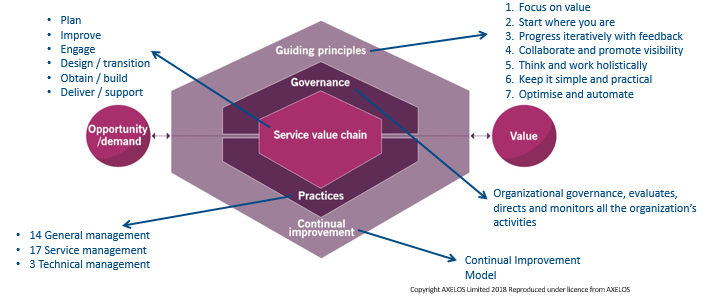
The service value System (SVS) represents “how all the components and activities of an organization work together to facilitate value creation”. The ITIL 4 SVS includes several elements:
ITIL 4 includes 34 management practices as “sets of organizational resources designed for performing work or accomplishing an objective”. For each practice, ITIL 4 provides various types of guidance, such as key terms and concepts, success factors, key activities, information objects, etc.
The 34 ITIL 4 practices are grouped into three categories:
The service management practices in ITIL 4 include:
Business analysis
Service catalogue management
Service design
Service level management
Availability management
Capacity and performance management
Service continuity management
Monitoring and event management
Service desk
Incident management
Service request management
Problem management
Release management
Change control
Service validation and testing
Service configuration management
IT asset management
Technical management practices
The ITIL 4 technical management practices include:
Deployment management
Infrastructure and platform management
Software development and management
ITIL 4 and ITIL V3: What’s the difference?
ITIL 4 does not attempt to introduce new basic ideas in service management and should be seen as an expansion, not a replacement, of the time-tested ITIL system. ITIL 4 and ITIL V3 essentially give guidance based on the same principles, but ITIL 4 adopts a new approach to this guideline.
ITIL V3 contains detailed descriptions of 26 ITIL processes, arranged along the service lifecycle:
Service Strategy
Service Design
Service Transition
Service Operation
Continual Service Improvement
The service lifecycle has been dropped in ITIL 4 and the processes replaced with practices. But many of the ITIL 4 practices clearly correspond to the previous ITIL V3 processes.
Other than that, ITIL 4 introduces additional guidance, to ensure practitioners better understand the core principles and concepts such as “value” and “outcomes”.
ITIL 4 also provides advice for integrating ITIL with other frameworks and methodologies like DevOps, Lean and Agile.
Last class we were discussed about ITSM ( IT Service management and its flavors. this blog post denotes about ITSM.
What is ITSM ?
IT service management (ITSM) refers to the entirety of activities – directed by policies, organized and structured in processes and supporting procedures – that are performed by an organization to design, plan, deliver, operate and control information technology (IT) services offered to customers. (https://en.wikipedia.org/wiki/IT_service_management )
ITSM (or IT services management) refers to all activities involved in the design, creation, delivery, support and management of the IT services lifecycle.
Okay, of course, but what are IT products, of course? Think of any equipment you use at your office–your computer, the software installed on your desktop, the printer that your team uses, or your password can be reset afterwards
Why does ITSM matter and it’s importance ?
For a variety of reasons, ITSM is essential. ITSM implementation can lead to regularization of processes through standardized delivery and documentation. The introduction of ITSM also aims to save money through the development of a stable IT body. Implementing ITSM has business benefits by providing the client with actionable IT perspectives that support decision-makers.
Benefits of ITSM Processes
IT Service Management (ITSM) aligns the delivery of IT services to an organization’s business needs. This integrates separately controlled This systems and modules with the goal of providing end-to-end services to customers, which stress the value of ITSM. All collaborative processes are developed using an IT service delivery framework. ITIL and Microsoft Operations System are some of the popular IT service management best practise frameworks. The ITSM advantages give an organisation significant success. A system of IT service management calculates quality with precisely defined and tracked metrics. This relentless commitment to monitor and continuously improve IT service delivery in pursuit of business goals greatly improves the operational efficiency of the organisation. By comparison with other IT management practises focused on the network, infrastructure or systems, ITSM aims to improve IT customer service without delay and with business objectives in a seamless manner. When technology grows in today’s digital industries, IT services management has become an important factor in helping business. ITSM tools complement the ITSM activities of an organisation by customer service consolidation, usually starting with an IT help desk. This software suite assists IT departments in managing ticketing systems, tracking and detecting deficiencies in their services and products. IT Service Management Instruments (ITSM) standardise IT services delivery within an organisation, based on budgets, staff resources, procedures and performance. Ultimately, the ultimate goal of ITSM is to ensure that the engineering group priorities of an organisation are in accordance with the business goals.
Source : ITSM Training – Horizon Institute, Qatar
ITSM processes
The more structured an organisation is, the better its IT department is. This is one of the most critical ITSM benefits businesses are looking for. What other benefits do companies derive from ITSM, and what are these ITSM processes actually? The systems of ITSM are components of the structure of ITSM. The ITSM framework follows its core principles and illustrates how to handle IT resources. In the following steps, ITSM processes can be divided:
Service Strategy (SS)
This is the first and most critical stage in the process of ITSM. The ITSM benefit in this process is to help determine just what consumers want and to confirm that the service can be achieved financially. Service strategy gives an overview of the service portfolio of a client, financial management, management of business relations, etc.
Service Description (SD)
Allow strategic recognition of the services offered by an entity with a detailed description. One of the key benefits of ITSM at this point is ensuring that the delivery of IT services meets the requirements and that the company is able to provide services in a safe manner.
Service Transition (ST)
ST is responsible for auctioning the services of the agency. The advantage of ITSM in the ST stage is maintaining the stability of services, while making them dynamic through the sensible accommodation of changes. At this point, the processes are change management, release management, information management etc.
Service Operation (SO)
ensures that the services work without hindrance, promptly warding off any disruptions. There are 6 main processes that help SO do that:
Event management – Monitors and provides notifications on how the services are running
Incident management – Restores the normal flow of IT processes as soon as possible, in case of disruptions
Problem management – Caters to the underlying cause of incidents
Request fulfillment – Deals with low-risk, recurrent and pre-defined circumstances
Access management – Deals with accounts and passwords
Continual Service Improvement (CSI) – Constant improvement of the services delivered
Why does the business need ITSM ?
You are already doing ITSM in a little way if your company has more than a handful of workers and even if one of you is the appointed “IT man.” But as your business grows, you may need to take more mature processes to make the most of your ITSM investment.
These are ITSM’s most important advantages.
Reduce IT costs
Improve the quality of service
Improve customer satisfaction
Improve governance and reduce risk
Increase competitive advantage
Improve flexibility
Increase agility for new IT services
How to introduce ITSM processes
The more structured a corporation is, the stronger its IT department is. This is one of the ITSM’s most critical strengths. What other benefits do businesses obtain from ITSM, and what are these ITSM processes actually? The ITSM processes are the ITSM system components. The ITSM system follows its core principles and outlines the manner of operating IT resources. The processes of ITSM can be classified into:
Step 1: Assess the situation as-is
Step 2: Work out a strategy
Step 3: Chart a detailed plan
Step 4: Introduce ST and SO processes gradually (incident – problem – configuration – change – SLA).
Step 5: Check for implementation issues
Step 6: Improve IT service management and move to the next level of ITSM maturity, when it’s time
ITSM Frameworks
Several organisations also use different structures or specifications, for example COBIT plus ITIL.
Although many frameworks are available to manage ITSM, the Information Technology Infrastructure Library (ITIL) is the most popular ITSM framework. For companies having a number of different branches, divisions and locations worldwide, it is easy to understand how a company can meet its varied needs by incorporating multiple systems, procedures and standards into its ITSM processes.
47% use Information Technology Infrastructure Library (ITIL) for ITSM, which focuses on aligning IT services with the business needs
36% use Control Objectives for Information and Related Technologies (COBIT)
36% are using Business Process Framework (eTom) – commonly used by telecom service providers in the telecommunications industry
34% use Microsoft Operations Framework (MOF) – provides another framework for managing the IT life cycle
The other frameworks, processes, and standards all have their own set of users, but these are the big four that Forbes Insights respondents cited the most. Knowing the most standard frameworks and processes used by other establishments helps businesses fathom the choices available to meet their IT service delivery needs.
Future of ITSM
As with most technologies, the future of ITSM lies with AI. Gartner estimates that 66 per cent of its funds were spent on daily operations by IT companies to “maintain the lights.” AI in ITSM can simplify mundane work with improvements such as auto ticket settlement, task management and predictive maintenance. The future of ITSM will be strongly influenced by AI, with consequences from leadership to consumers throughout the divisions.
The Internet of Things (IoT) is a web-enabled system that collects, sends and acts on data that it collects from its environments using embedded sensors, processors and communication hardware. It is often known as an Internet of Everything (IoE). These devices, also referred to as “linked” or “intelligent” devices, often communicate to other similar devices, a process called machine-to-maschine communication (M2 M), and use each other’s data. Humans may communicate with the devices to set it up, to give instructions, or to access the data, but without human intervention the devices do most of their job on their own. All the small mobile components available in these days and the ever linear structure of our home and business networks have made their presence possible.
Connected devices often generate massive amounts of internet traffic, including data loads which can be used but can be used for other purposes. All these new data and the openness of devices to the internet raise concerns for privacy and safety.
Nevertheless, this software provides a level of knowledge we have never had before in real time. To order to keep them safe, we can track our homes and families remotely. Corporations can improve production processes and reduce waste material and unwanted downtimes. Infrastructure sensors in the city can help reduce traffic congestion and can inform us about crumbling infrastructure. Open devices can monitor environmental changes and warn us of imminent disasters.
Kevin Ashton coined the phrase “Internet of Things,” perhaps in 1999 as the name of a company presentation he made at his place of employment, Proctor & Gamble. Throughout his time there, Ashton had the idea of putting an RFID tag on each lipstick and interacting with a radio receiver on the rack to monitor orders, inventory and signal when it was appropriate to restock. He states that this collection of data can be used for solving other real-world problems[ sources: Ashton, Gabbai, Simmonds].
Phones ‘ Network contains billions of connected devices. You use integrated hardware and software to send and receive data via different communication protocols. You could use our smartphones to access the Internet, connect to some other hardware in our homes that serves as a hub or connect directly through our domestic internet service. We also send data to cloud storage servers and then incorporate and analyse it. We may typically use software or plugins to view the data on our smartphone or home computers. Some can even be programmed to change your profile on different social networks.
While most of us do not yet have intelligent homes full of interacting devices, the IoT is massive. It is estimated that there are already between 15 and 25 trillion connected devices in some quantity, whereby researchers are expected to increase to between EUR 50 billion and EUR 212 billion by 2020[ sources: FTC, Intel, McLellan, OIC]. Some experts are even forecasting that around one billion connected devices will be available by 2025[ source: Wasik].
As large as this number is, it would become less impossible once you know that you could just about anything in the sensors and small computer equipment. Many of us have a smartphone, a computer that is used for most connected devices and an IoT device itself. Wearable fitness trackers are also quite popular. And in almost every device you can consider, from bathroom to refrigerators— even shoes, embedded processing, sensing and communication equipment is added. Smart thermostats, smoke alarms and security cameras will monitor your behaviour to make energy efficient, allow you to view your home remotely, alert you when something is wrong, and make contact with emergency services easier. You can buy even tiny tags for your pets and children to pick up and track anything from your car keys.
Many more connected devices are already out or will hit the market. Right now, we all have smart devices that we can communicate with individually (often via separate telephone apps), but most of them don’t work together. Nonetheless, organisations and industry groups work on creating standards and frameworks to simplify the programming of all these tools, as well as to improve safety. Apart from home, most businesses and communities are or have already implemented innovations that contribute to the Internet of Things.
Once there are more devices, even those from different fabrics, that can function with other devices, we can automate many mundane tasks. We essentially gave both computing power and senses to common physical objects. You can read from our world (including from our own bodies) and use the information to adjust its own settings, signall other apps to do so, and add it to read. Many of them perform actions based on complex algorithms and not just the simple if-then directions of the embedded computing of their own processors or cloud servers.
Devices that relate to the Internet of Things are likely to be private, household, government, business and industrial spaces in the future, and any room that is not now affected. Our Internet-connected smartphones, which have sensors like accelerometers, gyroscopes, GPS and sometimes Hart rate monitors, are the smart devices that many people see and communicate with each day, but they are just the tip of the iceberg.
We have wearable devices such as fitness trackers and heart monitors in the personal field which use our phones to send and receive information. Including Apple Watch and Pebble, smartwatches do these things and many more together with our phones. Clothing sensors and microprocessors aren’t far behind (and can now be produced using Arduino and other companies ‘ sewable boards and sensors). Even pets can be added to the “stuff” list to which sensors can be attached for tracking purposes. We also already have cameras that ship photos to the internet, scales that share our social media weight and toothbrushes that track our brushed habits.
Most household appliances, including heaters, water heaters, security cameras and lamps, are able to collect information, provide remote access and communicate via the Internet when a problem occurs. Some even learn to change your habits over time, or warn you about something suspicious. Instead of a traditional key, connected garage doors and electronic door locks can let you enter your home with data from your phone. Wi-Fi furniture and ovens can be tracked, turned off or remotely shut off. A fridge that can keep track of its contents and let you know what you are about or what you might do with your current ingredients for dinner is one of the hypothetical products that people bring up. Be assured, somebody works on it.
We are in the early stages of clever cities where whole metro stations are filled with sensors and other software. Devices that collect sensor readings and relay them are suitable for items like tracking the use of utilities; staff still need metre readings from the individual houses in most places. Intelligent devices may allow for monitoring of dangerous road conditions, pollution levels and consumption of water and energy. Roads will have sensors (and in some cases) to identify possible problems such as congestion and road conditions. In the vicinity of smart cars or smartphones, traffic delays can be warned. Certain potential applications include modifying traffic lights to respond in real time, tracking waste disposal systems to find out when pickup is needed and providing information on the parking available. Scientists work on small sensors for cement and other materials to identify the physical condition of the building itself, before structural issues lead to accidents like the collapse of the bridge.
Cars are cleverer, too. GPS in cars has been a thing for years and we have usable toll tags, which automatically pay as you drive through toll stations, but we are starting to add more sensors and computer functions to vehicles. Including speed and fuel efficiency, smartcars will serve as entertainment and data centres, provide other appliances with WiFi and track driving metrics. And then, one day, there will probably be self-driving cars that allow you to drive without hands or eyes while monitoring the road and surrounding vehicles for crashes. Cars and services are already available that allow you to start or locate your car and unlock doors remotely as well as to contact emergency services and roadside assistance.
Most connected devices are currently in use in the healthcare industry and many more are under development. Doctors and other caregivers can track vital signs and movement of patients remotely and save lives and maybe allow the elderly to live independently longer. Embedded sensors can also gather important data on patients in hospital beds and clothes, and scientists work on products such as carpets that can track drops and small computing devices that can be implanted into the human body.
For manufacturing and other businesses, even more smart devices are available where unmanaged control can save a lot of time and money. GE experimented with various sensors in the battery manufacturing ceramic mixing process. The scientists examined the data to determine what they needed to be aware of the appropriate ceramic mix, which helped them to achieve even consistency and reduced defect levels in a predictable manner[ source: Wasik]. The state and quality of goods can be tracked from initial materials throughout the production process. Similar monitoring can be extended to almost any organisation. In retail, inventories can be monitored and alerts can be sent when products need to be restored. Irrigation and other needs can be tracked in farming, soil and plants, and livestock can be marked and found. Climate controls can be streamlined in office buildings to reduce energy consumption and reduce costs. The odds are infinite.




 SINHARA'S NMIT Blog